
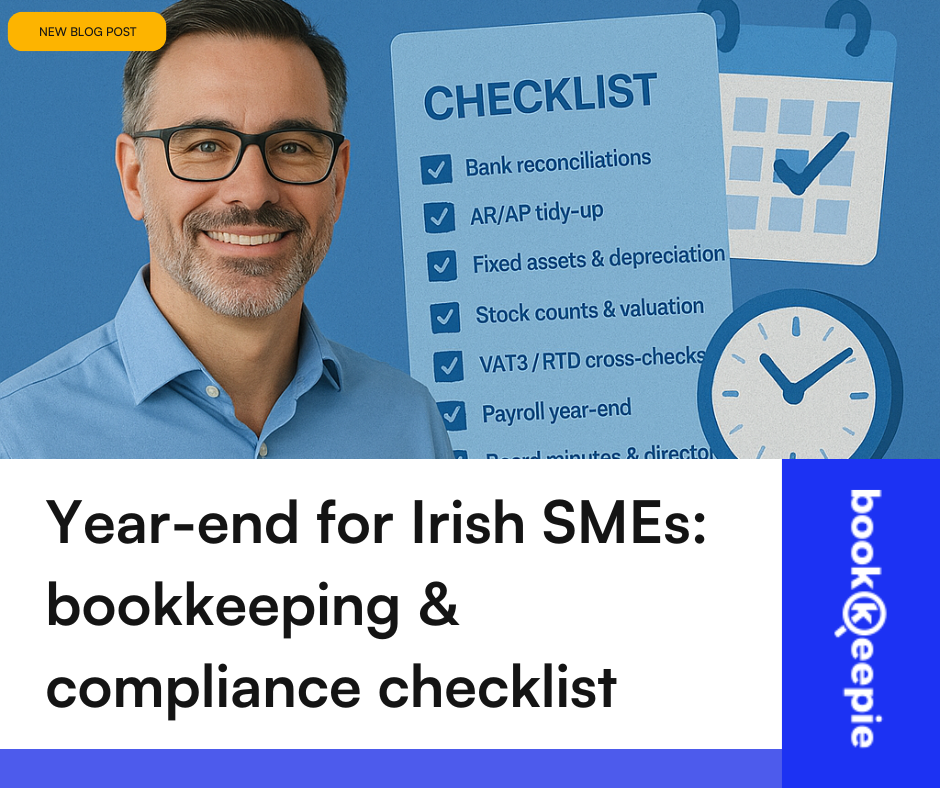
Year-end doesn’t need to be frantic. With a simple rhythm and a clear checklist, you can close the books calmly, give your accountant what they need, and file on time with Revenue and the CRO.
Use this guide as your practical companion to year-end.
Month-end rhythm (so year-end isn’t a disaster)
If you tidy up monthly, year-end becomes a formality.
Every month, aim to:
● Reconcile banks, cards and payment processors (PSPs).
● Review VAT, payroll and fixed assets.
● Keep neat workpapers your accountant can follow in seconds.
If you already do this, your “year-end” is mostly just running reports and answering a few questions. If not, this checklist will help you catch up and build a better habit for next year.
1. Bank, card& payment processor (PSP) reconciliations
Bank and PSP reconciliations are the foundation of clean accounts. If the opening and closing balances don’t match reality, everything built on top is shaky.
At year-end:
● Download all statements
○ Bank accounts, credit cards, merchant accounts, Stripe, Sum-up, PayPal, Revolut, etc.
● Reconcile every account to your software
○ Match each transaction to invoices, bills or expense records.
○ Investigate unexplained differences and timing issues.
● Document your reconciliations
○ Save reconciliation reports and a short explanation of any remaining differences.
○ These work papers are invaluable for accountants and, if you’re ever selected, for an audit trail.
2. AR/AP tidy-up & aged lists
Your aged receivables (who owes you) and aged payables (who you owe) tell a big part of your financial story.
Receivables (AR):
● Run an Aged Receivables report.
● Chase overdue customers and agree payment plans where needed.
● Discuss possible bad debt provisions or write-offs with your accountant.
Payables (AP):
● Run an Aged Payables report.
● Match supplier balances to statements where available.
● Clear duplicate or incorrect entries.
● Make sure the year-end cut-off is correct: invoices dated before year-end should be in this year, even if paid later.
Neat AR/AP lists make your balance sheet more reliable and support your corporation tax computation.
3. Fixed asset register & depreciation
Irish SMEs often under-maintain their fixed asset registers. That leads to confusion (“Do we still have that machine?”) and messy depreciation.
Your year-end actions:
● Update the fixed asset register
○ Add all new assets purchased during the year.
○ Record cost, purchase date and useful life.
● Remove disposed assets
○ Identify assets you’ve scrapped or sold.
○ Remove them from the register and record any gain/loss in the accounts.
● Post depreciation
○ Agree depreciation policies with your accountant.
○ Post year-end depreciation journals so the P&L and balance sheet are accurate.
A clean asset register helps with tax, insurance, and investment decisions.
4. Stock counts & valuation(where relevant)
If you trade in goods or hold materials, stock (inventory) is usually a key balance.
For businesses with stock:
● Do a physical stock count at or close to year-end.
● Value your stock consistently:
○ Typically at cost, or lower of cost and net realizable value.
● Identify obsolete or slow-moving items
○ Consider write-downs where stock is no longer saleable at normal prices.
● Keep solid records
○ Count sheets, valuation workings, and any adjustments.
Accurate stock improves your gross margin analysis and supports both tax and audit requirements.
5. VAT3 &RTD cross-checks
VAT in Ireland is reported through periodic VAT3 returns and an annual VAT Return of Trading Details (RTD). The RTD must reconcile with your full-year sales and purchases and is generally due by the 23rd of the month following the end of your accounting period.
At year-end:
● Check all VAT3 returns are filed and paid
○ Ensure each period for the financial year is submitted via ROS and reconciles to your bookkeeping records.
● Prepare RTD figures
○ Use full-year totals for:
■ Irish sales
■ Intra-EU acquisitions and supplies
■ Non-EU imports/exports
○ Make sure the categories align with Revenue guidance.
● Reconcile RTD to VAT3 and accounts
○ Totals reported on the RTD should agree with:
■ The sum of your VAT3 returns for the year, and
■ The revenue and purchases per your accounts (with clear explanations for any timing differences).
Early RTD prep helps avoid penalties, queries and last-minute panic.
6. Payroll year-end tasks
Since PAYE Modernization, Irish employers report payroll to Revenue in real time, but year-end is still a crucial reconciliation point.
Your payroll checklist:
● Reconcile payroll to ROS
○ Compare total gross pay, PAYE, USC and PRSI per your payroll software to Revenue’s statements on ROS and resolve any differences.
● Review taxable benefits
○ Ensure benefits-in-kind (BIK), company cars, health insurance, vouchers and other perks are properly recorded.
● Check employee data
○ Confirm PPS numbers, addresses, and PRSI classes are correct for all employees and directors.
● Document processes
○ Keep notes of any corrections made so your accountant (and future you) can follow the logic.
Getting payroll right avoids Revenue issues and gives employees confidence that their tax is correct.
7. Board minutes & director confirmations
Under the Companies Act 2014, Irish companies must keep minutes of directors’ meetings and company decisions as a permanent record.
Year-end is an ideal moment to formalize what actually happened.
Governance to-dos:
● Prepare board minutes
○ Approving the financial statements (where relevant).
○ Recording key decisions around dividends, director remuneration, and going concern.
● Director confirmations
○ That the company has kept proper books of account.
○ That the financial statements give a true and fair view (for companies preparing statutory accounts).
● CRO annual return planning
○ Check your Annual Return Date (ARD) and filing deadlines.
○ Annual returns (Form B1) must be filed with the CRO within 56days of the effective date.
Good minutes and timely CRO filings reduce the risk of late-filing penalties, audit exemption loss, and other compliance headaches.
8. Build a calm month-end, not a crazy year-end
The most effective Irish SMEs treat year-end as “just another month-end” with a bit more paperwork:
Each month:
● Reconcile banks, cards and PSPs.
● Keep VAT and payroll fully up to date.
● Save workpapers in a clearly named, cloud-based folder.
● Maintain a short list of questions for your accountant, instead of a year-end brain dump.
Do this, and by the time your year actually ends, your books are already in good shape.